36,000 Kilometers Above Earth: How Kazakhstan Controls Its Satellites from the Akkol Steppe
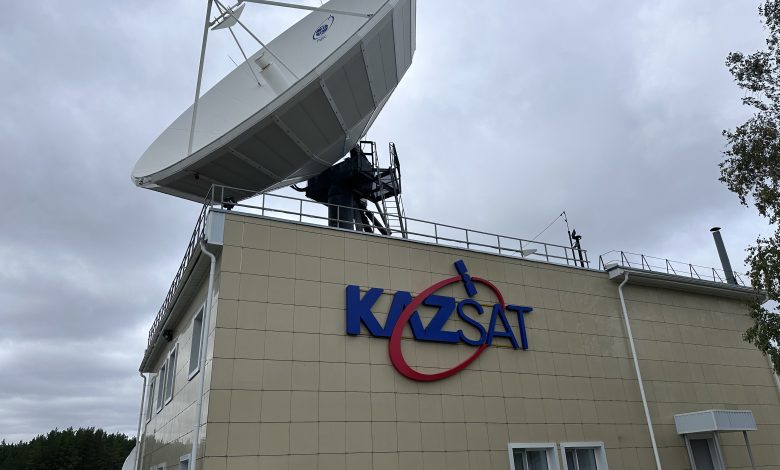
Kazakhstan – Massive antennas rising from the steppe, continuously flickering screens, and specialists working around the clock to monitor objects located 36,000 kilometers away from our planet. Journalists from Tiek.kz visited the Akkol Space Communication Center to discover what really happens behind the giant satellite dishes.
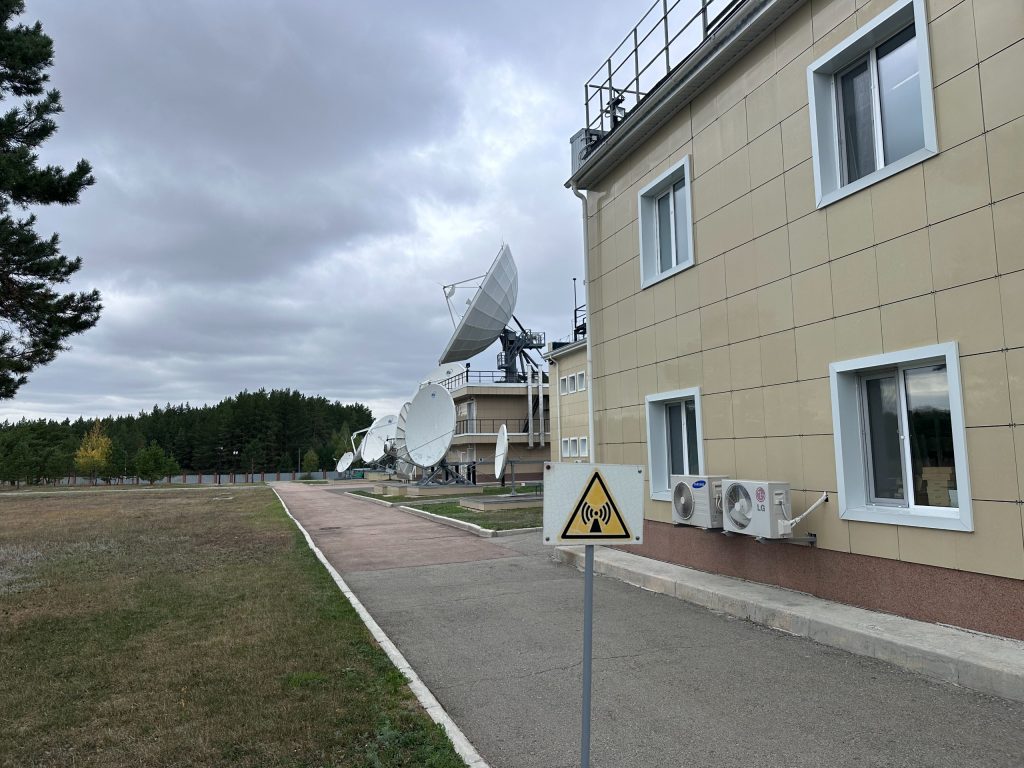
From the highway, the complex looks almost surreal. Amidst the familiar, endless steppe landscape, colossal metal structures and technical buildings pierce the skyline. You won’t find roaring rockets, launch pads, or bulky spaceships here. There are only skyward-pointing antennas that bridge Earth with Kazakhstan’s geostationary satellites: KazSat-2 and KazSat-3.
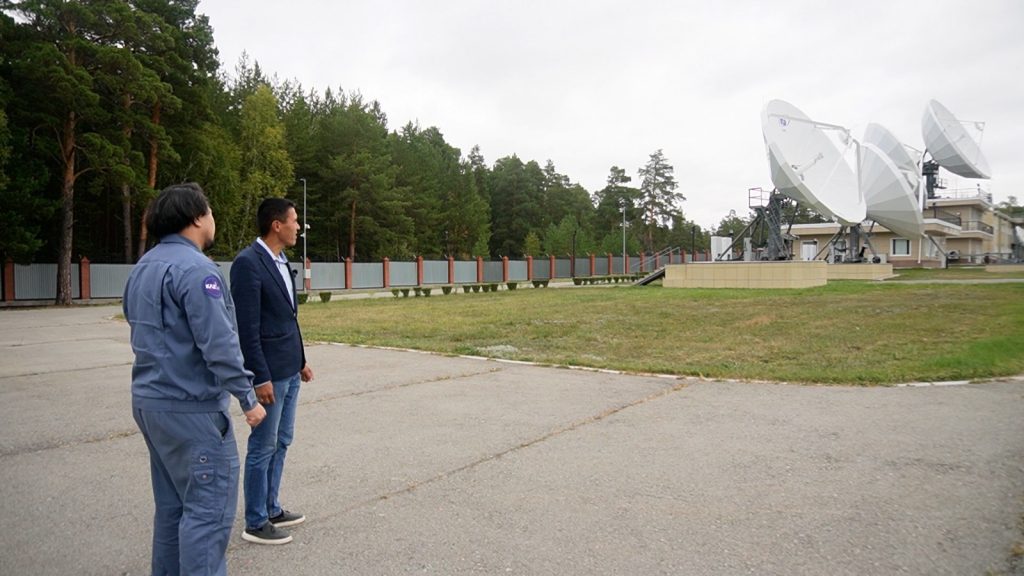
Abylay Karimov, an engineer in the communications monitoring department, guides us through the facility. The antennas here differ not only in their cyclopean size but in their function: some receive signals, others transmit them back into space, while a select few are dedicated exclusively to direct spacecraft control.

Invisible Satellites and “Joystick-Free” Control
The spacecraft orbit at an altitude of approximately 36,000 kilometers. Naturally, it is impossible to see them from the ground. But for the engineers, distance is no obstacle: monitors display everything that remains hidden to the human eye.
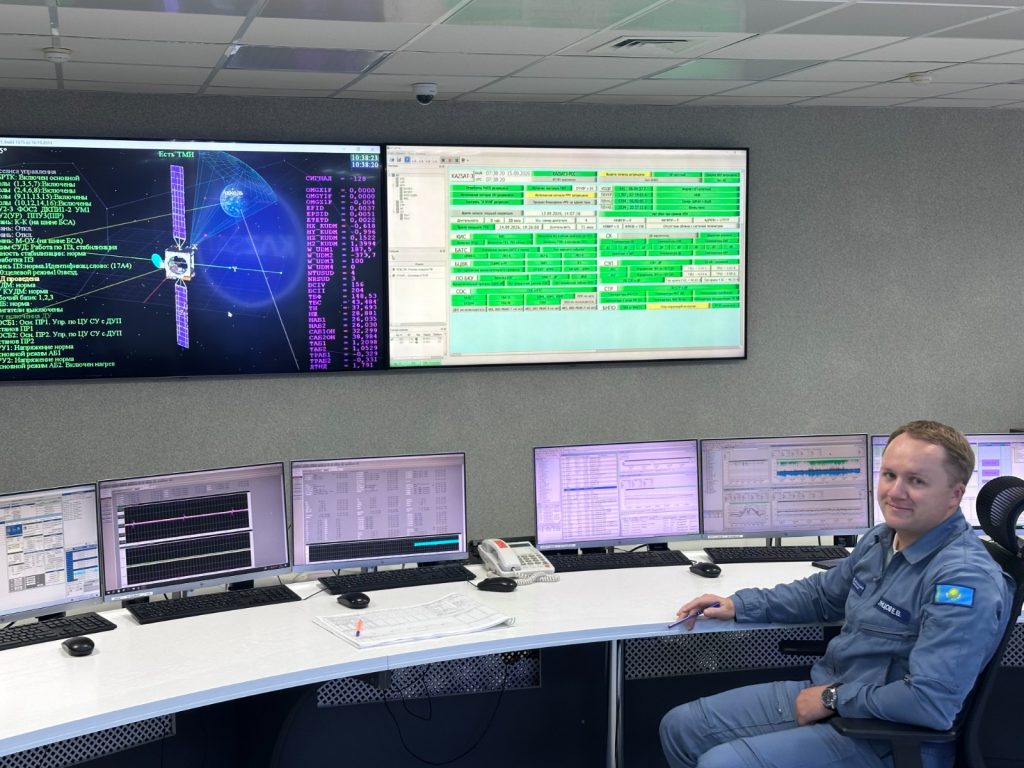
The Mission Control Center (MCC) looks more like an analytical laboratory than a sci-fi pilot’s cabin. There are no control levers, steering wheels, or joysticks. Evgeny Suntsov, an engineer in the flight control department, explains that piloting a satellite relies entirely on rigorous mathematical calculations.
“The Mission Control Center consists of three departments: Ballistics, Planning, and Control,” the engineer explains.
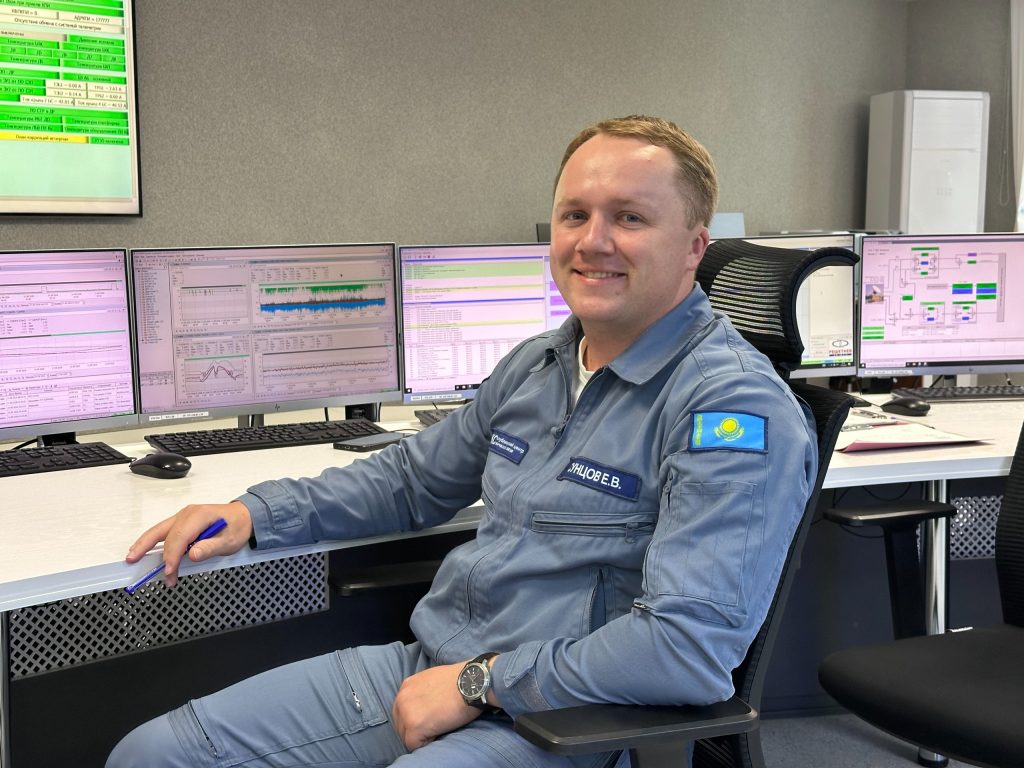
Operations run in weekly cycles. First, the ballistics team calculates the satellite’s exact position and forecasts its trajectory, factoring in the gravitational pulls of the Earth and the Moon. Then, the planners step in.
“The Planning Department takes all this into account. They schedule which engines will fire, at what precise time, and for exactly how long, along with other critical operations.”
Only after this rigorous process is the finalized command packet uploaded to the spacecraft. “We send this flight task to the satellite, and it operates for a week, executing the corrective impulses—meaning engine burns—on its own,” Suntsov adds.
No one manually “steers” the satellite. The spacecraft autonomously executes its pre-programmed correction algorithms, while the engineers simply monitor the precision of the execution. “It is a lengthy and entirely predictable process. There are no sudden surprises here,” Suntsov notes.
5,000 Parameters and Orbital “Parking Neighbors”
In one of the monitoring rooms, graphs and numbers cascade endlessly across screens. To an outsider, it looks like a chaotic jumble of lines; to an operator, it is the detailed electrocardiogram of a spacecraft.
“We monitor several thousand parameters for each satellite. This includes currents, voltages, temperatures, instrument readings, and the status of every onboard system,” Suntsov explains.
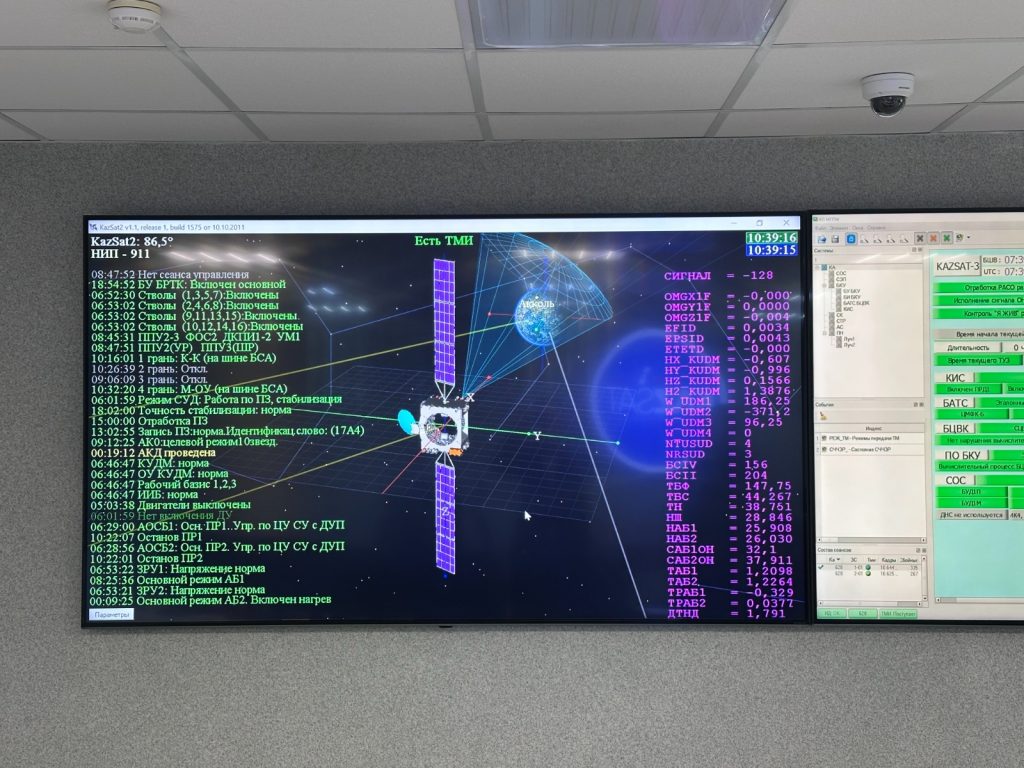
Engineers stand watch 24/7. If even a single metric deviates from the norm, the system immediately sounds the alarm. “Because there are over 5,000 parameters on each satellite, we rely on automated visual and audio alarms.”
Space dictates harsh conditions. First, there are extreme temperatures. In a vacuum, conventional heat exchange does not exist. “On one side of the satellite it might be +30°C, while on the other it’s -5°C,” Suntsov says, pointing to a scale model.
Second, resources are strictly limited. The satellites use xenon gas for maneuvering (stored in two 70-kg tanks). Although fuel consumption is highly efficient, it must last the spacecraft’s entire operational lifespan. “You can’t cut it close. If you run out of fuel, your satellite is stranded in orbit.”
Furthermore, geostationary orbit is not a boundless void—it is a strictly regulated zone. “We have neighbors to the left and right,” the engineer says, drawing a relatable analogy. “It’s like a parking lot; we can’t just take up space recklessly.”
This is why a decommissioned satellite is never simply abandoned to drift. It is carefully propelled into a higher “graveyard orbit,” freeing up its valuable orbital slot for newer spacecraft.
13 Meters of Metal and Cosmic Noise
The pride of the center is the MCC’s colossal 13-meter antenna aimed at the heavens, which is responsible for beaming telecommands into orbit. However, equally critical work happens next door in the Monitoring Control Center.
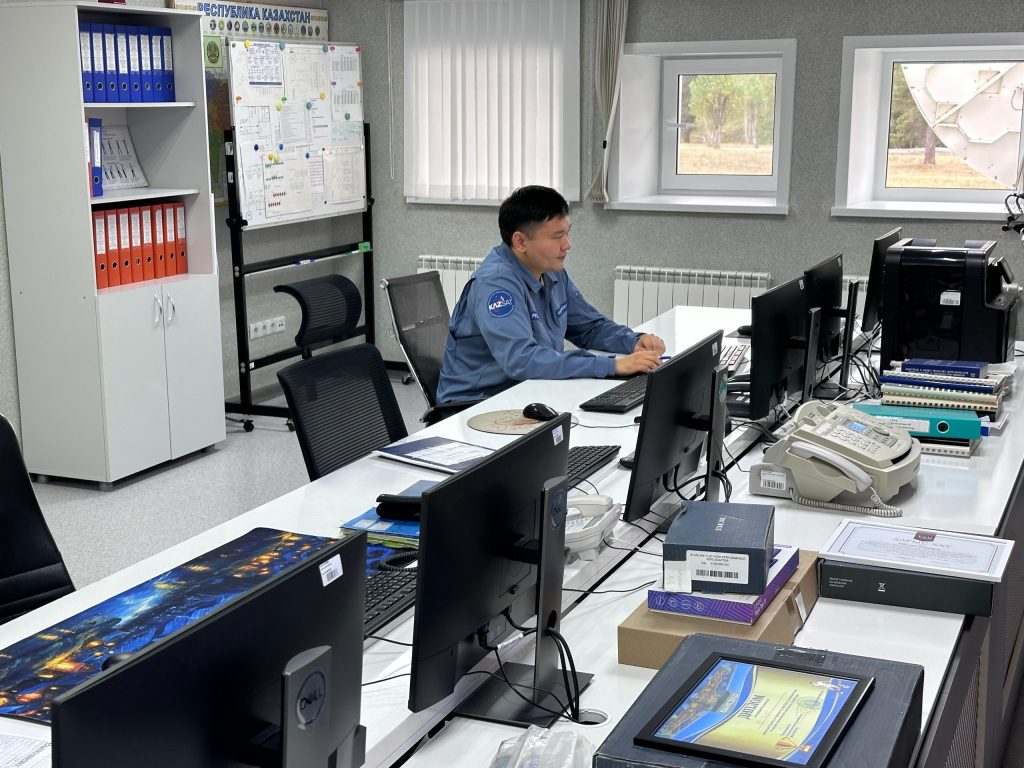
Here, specialists manage the frequency and energy resources of the satellites, meticulously filtering out natural cosmic noise—such as solar and lunar radiation—from man-made technological interference.
“We have people here 24/7. They constantly monitor the radio spectrum and take corrective measures whenever necessary.”
KazSat: Nationwide Connectivity, Not Surveillance
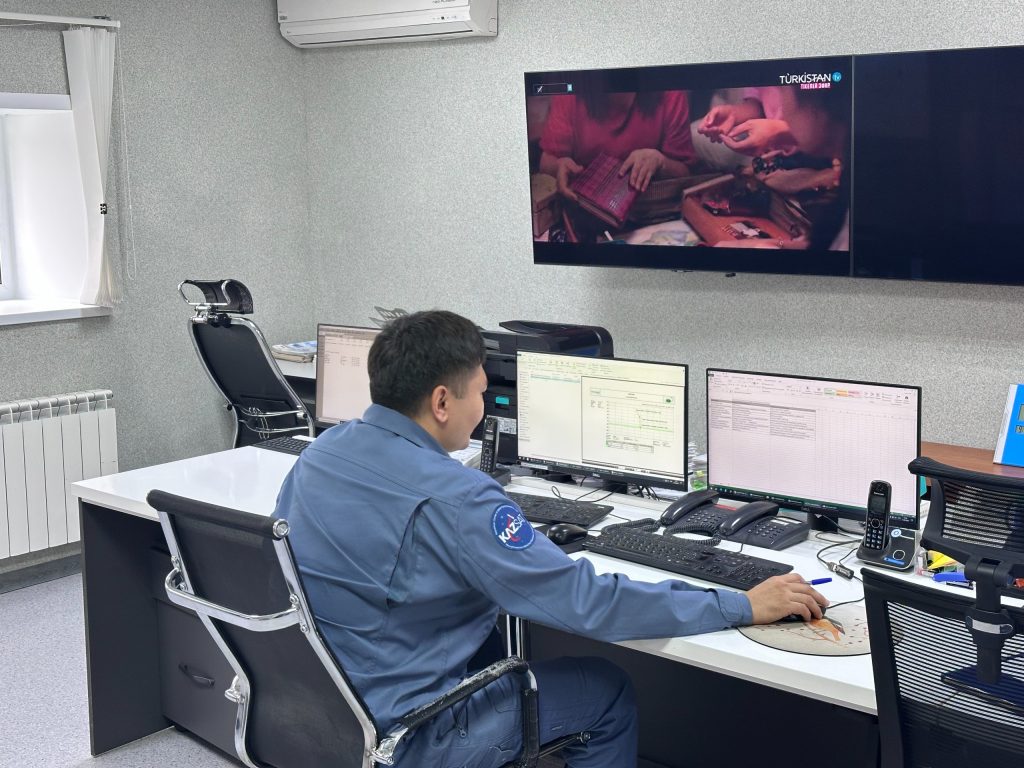
Many mistakenly believe that satellites are used exclusively for video surveillance of the Earth’s surface. Bolat Seyitov, Director of the Planning Department at the JSC Republican Center of Space Communication (RCSC), clarifies this misconception: “Their primary function is communications.”

For Kazakhstan—a nation with a vast territory where laying fiber-optic cables to every remote village is economically unfeasible—satellite broadcasting remains the only viable way to provide the population with television and internet access.
The national space system guarantees the country’s independence from foreign providers. The financial impact speaks for itself: from 2011 to the first half of 2026, the KazSat program has saved Kazakhstan an estimated 130 billion tenge.
A Generational Shift: Retiring KazSat-2 and Awaiting KazSat-3R
The center is currently undergoing a vital transitional phase. The lifecycle of KazSat-2 is coming to an end, and its operational load is being carefully transferred to other capacities.
“This migration has already begun. For ordinary Kazakhstani citizens, this transition is completely invisible. Everything is proceeding exactly according to plan,” Seyitov notes.
Connectivity will not be interrupted. As the current KazSat-3 continues its mission, preparations are already underway for the next generation. “The new spacecraft will be named KazSat-3R, and it is expected to be technically far superior to the current KazSat-3.”
Destinies Tied to Space
Engineer Nurtay Saifullin has worked at the Akkol center for six years, but his connection to the cosmos began long before he arrived.
“I was born in Baikonur. My father was connected to space; he worked at the spaceport’s Zenit assembly and testing facility.”

A graduate of an aviation institute, Saifullin today sits not on a launch pad, but in front of telemetry monitors. And while the job lacks Hollywood-style action, the weight of responsibility is no less immense.
“Sometimes it’s thrilling, sometimes it’s very quiet. But it is work, and the work must be done,” Saifullin admits with a smile.
In fact, this quiet routine is the ultimate measure of the center’s success. The calmer it is in the control room, the better. It means the satellites are holding their orbits perfectly, the signal is uninterrupted, and the systems are running like clockwork.
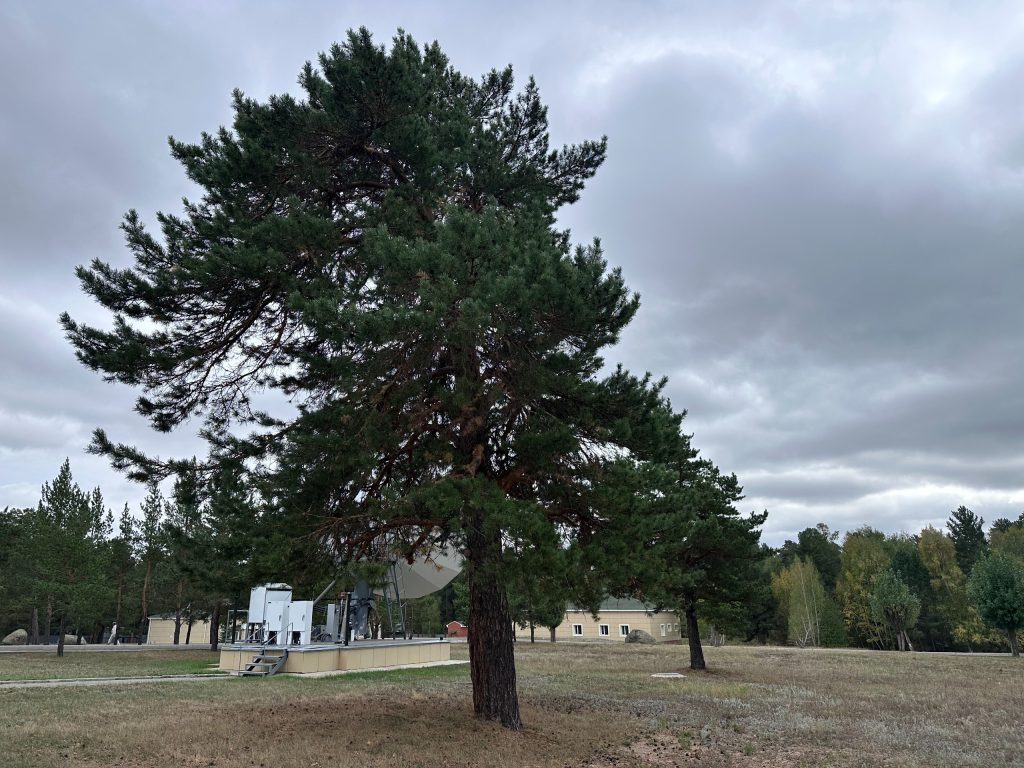
As we leave Akkol, the metallic dishes once again look like static structures in the steppe. But now we know the truth: right at this very moment, in absolute silence, ballistics experts are calculating orbits, operators are transmitting commands, and unimaginably high above—36,000 kilometers from Earth—Kazakhstan’s satellites continue their invisible, yet indispensable work.