Economic Prospects: What Kazakhstan Gains from Unpopular Decisions
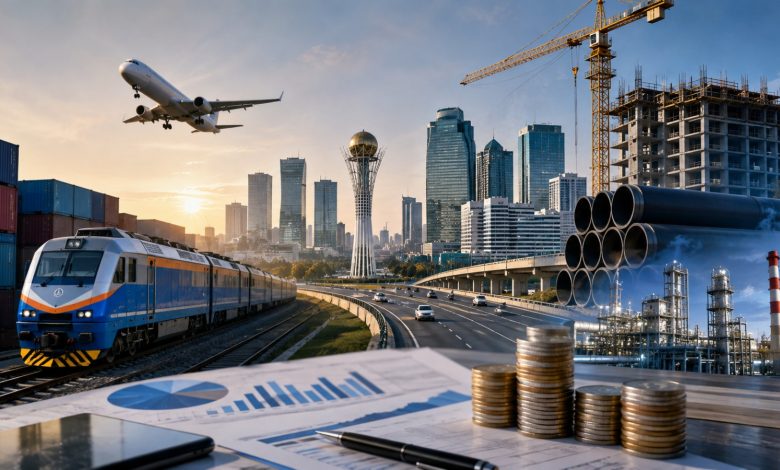
Economic policy is easiest to assess through decisions whose effects are immediately visible: completed facilities, new housing and kilometres of roads. It is much harder to see changes that accumulate over several years and gradually reshape the very structure of the economy, Tiek.kz reports.
This is precisely the process currently taking place in Kazakhstan. If the results of the past three years are viewed not as a collection of individual indicators but as a trend, a more important development becomes apparent: growth is gradually gaining a new production and infrastructure base. Manufacturing is expanding, private investment is increasing, exports of processed goods are growing, while the state is accelerating the modernisation of transport, energy and utility infrastructure.
“Kazakhstan has strong economic growth and a favourable investment climate. The other day, the three major global agencies upgraded the country’s credit rating. One of the reasons is that oil has become more expensive, and accordingly, Kazakhstan’s rating as an oil exporter has improved. This means that loans for Kazakh companies will now become cheaper, while conservative investors will be willing to pay more for the country’s securities. This is an important step in the country’s development. Naturally, this is an achievement of the authorities — the President and the Government — because oil is one thing, but you also need to know how to take advantage of favourable market conditions,” said Russian economist and financial analyst Alexander Razuvaev.
Manufacturing Is Becoming an Independent Growth Driver
One of the most telling processes is taking place in industry. Manufacturing output increased from 22 trillion tenge in 2023 to 25.1 trillion in 2024 and 30.7 trillion tenge in 2025 — almost a 40% nominal increase over two years. At the same time, manufacturing’s share of industrial production rose from 46.9% to 49.1%. At least 370 new industrial projects were commissioned in 2024–2025 alone.
Importantly, this trend is also beginning to show up in foreign trade. Exports of processed goods amounted to $25.7 billion in 2023, $28.8 billion in 2024 and $28.7 billion in 2025. In the first half of 2026, they increased by 17.5% to $15.2 billion, while total exports grew by 8.6%. The economy is not only producing more goods domestically; some of this additional output is proving competitive in international markets.
From January to July 2026, fixed capital investment increased by 7.7%, while private investment grew by 19%. The government can initiate an investment cycle through budget spending, preferential financing or infrastructure projects. However, the long-term sustainability of this cycle emerges only when private capital begins investing alongside the state. That is why the faster growth of private investment is one of the most interesting developments of recent years.
Infrastructure as Part of Economic Policy
For a long time, infrastructure spending in Kazakhstan was viewed primarily as a social issue: repairing a road, supplying a settlement with water or preparing a thermal power plant for winter. For the economy, however, infrastructure is just as much a factor of production as capital or labour.
During the 2024–2025 road construction seasons, 13,600 kilometres of roads were repaired, more than 2,800 kilometres of railway tracks were restored, construction of 836 kilometres of the second tracks on the Dostyk–Moyynty line was completed, and traffic was launched on a 75-kilometre bypass line around Almaty. The capacity of the new terminals at the airports of Almaty, Shymkent and Kyzylorda increased from 3.5 million to 23 million passengers per year.
“The transport and logistics sector is becoming one of the new sources strengthening Kazakhstan’s economic position. Expanding the capacity of the Trans-Caspian International Transport Route is important not only for transit: this potential is becoming an economic resource for the country and strengthening its position as an important link in international logistics. Growing traffic along the Middle Corridor shows that infrastructure projects are gradually turning into an independent factor of economic development,” political scientist Aigerim Bakhtiyarova believes.
The economic impact of such projects is measured by much more than construction costs. Increased railway capacity affects exports, new roads support domestic trade and mobility, while airports stimulate business activity and tourism. These are investments whose benefits continue for decades after budget financing has ended.
“Over the past few years, the very paradigm of public administration has changed. Alongside implementing government policy, important tasks for the Government now include meeting citizens’ needs in a timely manner, ensuring economic returns and protecting national interests.
“Today, priorities are linked not only to maintaining current growth, but also to creating conditions for further development: attracting investment, modernising transport and logistics, ensuring macroeconomic stability, digitalisation and developing human capital. Therefore, infrastructure projects should be viewed not only as expenditures, but also as investments that create new opportunities for economic growth,” Aigerim Bakhtiyarova noted.
The Cost of Modernisation
Structural reforms, however, almost always have a downside. The most obvious example is utility and energy infrastructure. The tariff increases of recent years can hardly be called popular decisions. They directly affect household expenses and additionally contribute to inflation. By the time the “Tariffs in Exchange for Investment” programme was launched, however, the choice was effectively no longer between raising or not raising tariffs. The choice was between financing accumulated deterioration now and continuing to postpone the problem.
For years, relatively low utility prices were accompanied by insufficient investment in networks and equipment. As a result, by 2023, the deterioration rate of heating infrastructure had reached 54%, water supply infrastructure 40%, and wastewater systems 56%. Maintaining the previous model would effectively have meant subsidising current service costs at the expense of future infrastructure reliability.
The Government chose a different path — politically less comfortable, but economically more rational. The “Tariffs in Exchange for Investment” mechanism was initially created to attract additional investment into the modernisation of networks and equipment. At the same time, regulated tariff increases were introduced gradually, taking into account the socio-economic situation in the regions. Here, it is crucial to assess whether the additional tariff burden is actually being converted into real investment.
In 2024–2025, more than 500 billion tenge annually was allocated from various sources — the budget, companies’ investment programmes and the “Tariffs in Exchange for Investment” mechanism — for repairs to power generation facilities, heating and electricity networks.
The result is already being measured not simply by the number of repairs completed. The deterioration of the main equipment at power plants decreased from 55% in 2024 to 53% in 2025. Following the 2025–2026 heating season, five thermal power plants remained in the high-risk red zone, while the number of facilities in the stable green zone increased to 13.
In other words, the very result for which the unpopular decision was made is beginning to emerge: additional expenses are being transformed into lower infrastructure risks.
Do Not Shift the Entire Cost of Modernisation onto Consumers
The need for infrastructure investment does not mean that the entire cost of years of underfunding should be passed on to the population all at once. This is where the structure of government policy becomes considerably more complex than the simple formula of “raise tariffs — get investment.”
Modernisation is being financed from several sources. Moreover, the new national project provides for subsidised interest rates on loans specifically to reduce the impact of large-scale infrastructure investment on tariffs.
At the same time, the national project explicitly provides for reducing the tariff burden on socially vulnerable citizens through housing assistance. Funding of 1.25 billion tenge was allocated for this purpose in 2025, with a gradual increase to 3.05 billion tenge by 2029. At the same time, the maximum permissible level of utility expenses for recipients of such support is expected to be reduced to 5% of their income.
This combination of instruments is fundamentally important. The state is not trying to freeze service prices for everyone regardless of income, as such a policy would once again deprive the sector of investment resources. Instead, part of the cost of modernisation is incorporated into the economically justified cost of services, part is financed by the state and enterprises, while the most sensitive burden on low-income families is eased through targeted support.
This model is more complicated than administrative tariff restraint, but it is significantly more sustainable in the long term.
From Shortage to Development
A similar logic can be seen in water supply. In 2024–2025, 643 projects worth approximately 460 billion tenge were implemented, while access to quality drinking water reached 100% in both cities and villages.
After universal access has been achieved, the objective changes. The focus now shifts to increasing the capacity of water sources and improving network quality. In 2025, 80 water utilities were modernised, more than 400 kilometres of networks were upgraded, and water supply was improved in 468 settlements.
In other words, government policy is reaching an important turning point: moving from eliminating physical shortages to improving quality and creating reserve capacity.
The same connection is emerging between utility infrastructure and housing construction. Housing completions increased from 17.8 million square metres in 2023 to 20.3 million square metres in 2025 — approximately 14% growth over two years. At the same time, the share of multi-apartment housing increased from around 63% to 67%.
This is particularly important for rapidly growing cities: building housing without a corresponding expansion of energy, water and transport capacity merely shifts the infrastructure deficit several years into the future.
The Effect Cannot Be Measured by a Single Year
This is why the effectiveness of current economic policy cannot be assessed solely through the indicators of a single budget or calendar year.
Many of the decisions made in recent years have a cumulative effect. A railway built today will transport cargo for decades. New energy capacity allows additional production facilities to be established. Modernised networks create opportunities for new residential districts. An industrial project, once launched, generates production, employment, tax revenues and exports. Private investment following government investment creates the next investment cycle.
This is the main change of recent years. The state is gradually moving from a policy of compensating for accumulated problems to a policy of creating conditions for the next stage of growth. In some cases, this requires decisions whose effects emerge later than their immediate social costs.
The key question is whether today’s costs are creating an asset that will generate benefits tomorrow.
The dynamics of manufacturing, private investment, non-resource exports, transport infrastructure and energy indicate that such a cumulative effect is already beginning to take shape in Kazakhstan. If this trend continues, the main result of the current stage will not be a single GDP growth figure, but something more fundamental: the economy will have a significantly broader production, infrastructure and investment base for further growth.