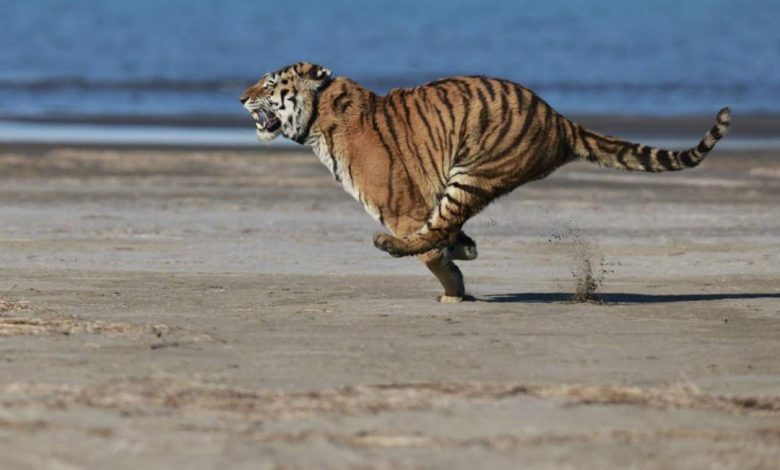
Balkhash — A historic event has taken place in the Ile-Balkhash State Nature Reserve: a male Amur tiger named Amur has been released into his natural habitat. He becomes the second predator released into the wild as part of Kazakhstan’s large-scale state program for tiger reintroduction, Tiek.kz reports, citing the Ministry of Ecology and Natural Resources of the Republic of Kazakhstan.
For over 70 years, the tiger population in Kazakhstan’s wild was considered entirely extinct. The return of these apex predators to their historical homeland was made possible through years of dedicated work to restore the region’s natural ecosystems.
The official release ceremony was attended by the Minister of Ecology and Natural Resources Alibek Kuantyrov, Chairman of the Forestry and Wildlife Committee Daniyar Turgambayev, General Director of the Amur Tiger Center Sergei Aramilev, alongside representatives of scientific organizations and wildlife specialists.
“Today, we have taken another vital step toward returning tigers to Kazakhstan. On July 31 of this year, a female named Umit was released into the wild. And today, we released our second tiger—a male named Amur. This historic event is the result of many years of joint effort. I express my immense gratitude to the Russian side, the World Wildlife Fund (WWF), and all our partners for their assistance. Our primary goal is not simply to return the predators, but to establish a sustainable population capable of independently surviving and reproducing in the wild,” emphasized Minister Alibek Kuantyrov.
Preparation and Adaptation of Amur
Following his transportation from Russia, Amur was housed in a specially equipped adaptation enclosure within the Ile-Balkhash reserve. Prior to his release, the predator underwent comprehensive veterinary examinations and behavioral tests.
Specialists meticulously evaluated his health, hunting instincts, ability to independently forage for food, and his reaction to humans. The test results confirmed the animal’s complete readiness for independent life. To ensure continuous monitoring of his movements and adaptation process, Amur was fitted with a specialized satellite tracking collar.
As noted by Daniyar Turgambayev, Chairman of the Forestry and Wildlife Committee, the release of each tiger carries immense responsibility, and specialists will maintain round-the-clock monitoring of the predators’ adaptation to their new environment. According to experts, the previously released female, Umit, is successfully acclimating to the reserve and is already hunting independently. Two tiger cubs that arrived with them currently remain under close observation by specialists.
Infrastructure, Prey Base, and Public Safety
Large-scale preparation for the tiger reintroduction began in 2018 with the establishment of the Ile-Balkhash Nature Reserve. To ensure a stable prey base for the predators, Bukhara deer and kulans (wild asses) were introduced to the region. Notably, in September 2026, 30 kulans were relocated to the reserve from the Altyn-Emel National Park.
The project also places a heavy emphasis on the safety of local residents. To prevent potential human-wildlife conflicts, a dedicated monitoring group has been established to track the tigers’ movements and maintain constant communication with the public.
Historically, the Ili River valley and the Southern Balkhash region were the natural habitat of the Turanian tiger, which was completely exterminated by the mid-20th century. Modern genetic research has proven that the Turanian and Amur tigers are close relatives, which is why the Amur subspecies was selected to restore the apex predator population in Central Asia.